This series of posts are not meant to be a systematic note about a specific topic. It’s a collection of learning notes on a few basic topics on crystallography and may come in a sort of random order, which may seem a bit messy at a first (second, or maybe even third) look. However, topics covered in the post are indeed relevant to each other since they were all emerging as I was trying to clarify my understanding for those relevant topics. I don’t remember which one of them did I start from – anyhow, as I dived into a specific topic, relevant new topics keep emerging and I was trying my best to scribble down whatever in my mind at that moment. So, the post here roughly follows my scribbles on the draft paper.
Crystal System
In the context of crystallography, the crystal system is an often mentioned notion. We all know that there are 7 of them, namely, triclinic, monoclinic, orthorhombic, tetragonal, trigonal, hexagonal and cubic. However, think about it – what do they really mean? I mean, what is the reference that we are referring to when dividing crystals into those 7 crystal systems? Is it based on the lattice? No, since we have 7 lattice systems – some of the names overlap with those of the crystal systems and some not. So, apparently, the crystal systems classification is not based on the lattice. Then, what is the reference? BTW, I mentioned the lattice system, but what is a lattice system and based on what do we classify lattices into those systems? Also, what…is a lattice? This is what I wrote at the very top – as we think through these stuff, all sorts of questions just pop up and quite often we would find that for a lot of topics that we think we are already pretty familiar with, it may still be a bit difficult to answer the easy question ‘what they are and why’.
So, what is a crystal system? Mathematically, point groups are classified into different crystal systems according to the shared (and distinctive to the class) symmetry element(s). For example, all the point groups belonging to the trigonal crystal class have a single 3-fold rotation axis. Saying this, it should become clear that the crystal system classification refers to the crystal structure (well, for sure). The reason to emphasize this is, by comparison, the classfication of lattice systems is refers to the lattice. Sounds like a crap, right? Well, no, because there comes a very important point about the lattice and the crystal structure. I will come back to this.
A detailed table for the member of point groups belonging to each crystal system can be found in Ref. [1].
Crystal Family
The classification according to the crystal family follows a very similar rationale like the crystal system and in fact they almost overlap, except that the crystal systems trigonal and hexagonal are put together to give the hexagonal family. From the perspective of shared symmetry elements, such a merging is understandable – point groups in the hexagonal crystal system share a 6-fold rotation axis and we know that two 6-fold rotation applied one after another yields a 3-fold rotation. So, no wonder why trigonal and hexagonal are merged into the same family. But why is the family NOT called trigonal? According to the Wikipedia page [2],
Crystal systems that have space groups assigned to a common lattice system are combined into a crystal family.
The common lattice system here is hexagonal and thus named for the crystal family.
N.B. It should be noted that ‘have’ as in the quoted statement above does NOT mean ‘all’ – as we can see in the table on Wikipedia [3], there are (meaning, ‘have’, as in the quoted statement) space groups that belong to the trigonal crystal system having the hexagonal lattice system but not all of them, since some of the space groups in the trigonal crystal system have the rhombohedral lattice system.
Lattice System
It has been mentioned a few times so it is time to stop by it. First, we need to clarify what a lattice is. So, lattice is a collection of abstract points where the environment surrounding each of the abstract points is identical. Uhm…the definition itself is a bit…abstract. Let’s be specific and I will take the very classical and representative example (which is probably every crystallography textbook would take) – a 2D honeycomb.
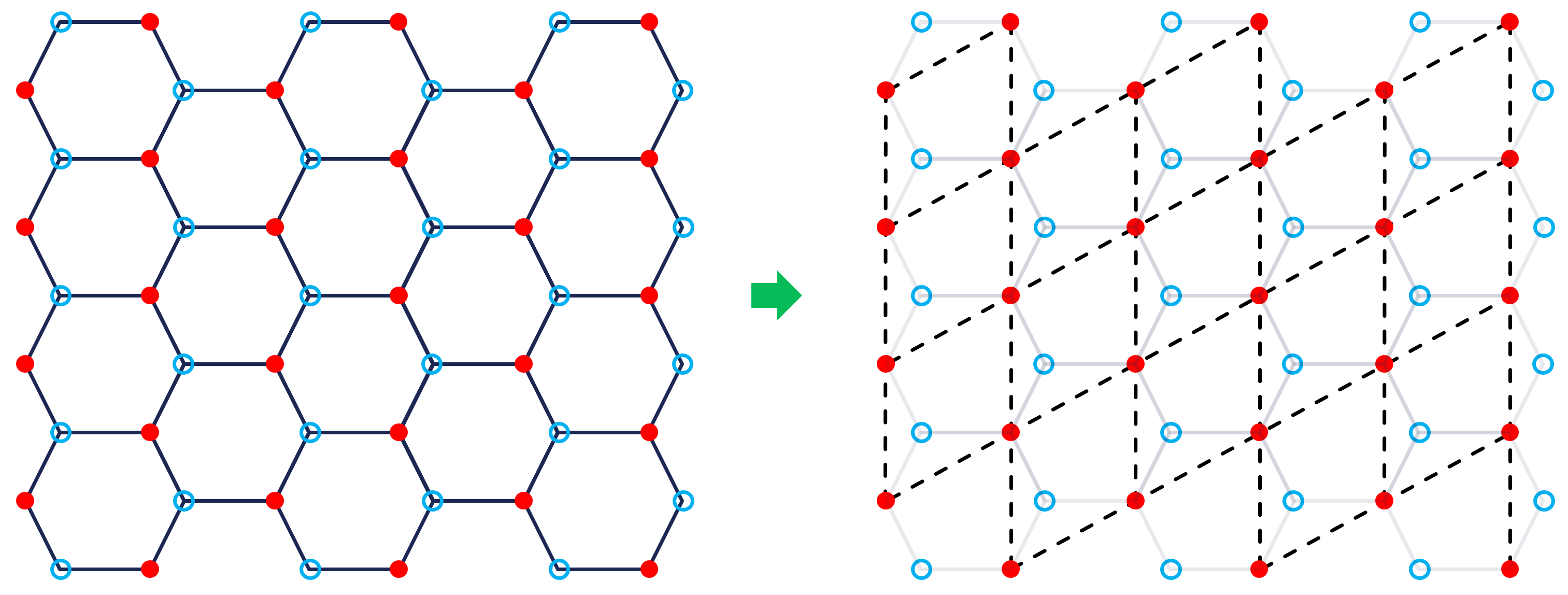
Here we show the honeycomb structure in 2D where I labeled the two distinctive local environment – standing on the red solid circle and the open cyan circle, looking to the left of the screen, we will see different environment. So, the intersection corners of the honeycomb structure themselves cannot be abstracted directly as the lattice. Instead, the figure on the right gives the actual lattice – the red solid circles can be abstracted as lattice points to give the lattice as indicated by the dashed framework. Now if we stand on those red circles and look around, the environment looks identical. So the lattice points are just those red solid circles? Uh…Yes and No. As mentioned already, lattice points are really abstract and not attached to any specific objects. It is more like a way of describing the periodicity of the underlying structure. In abstract algebra, it is actually an object in the affine space (see the previous note here). This is stepping too far off the topic here. Let’s put down an illustrative diagram to show what it means,
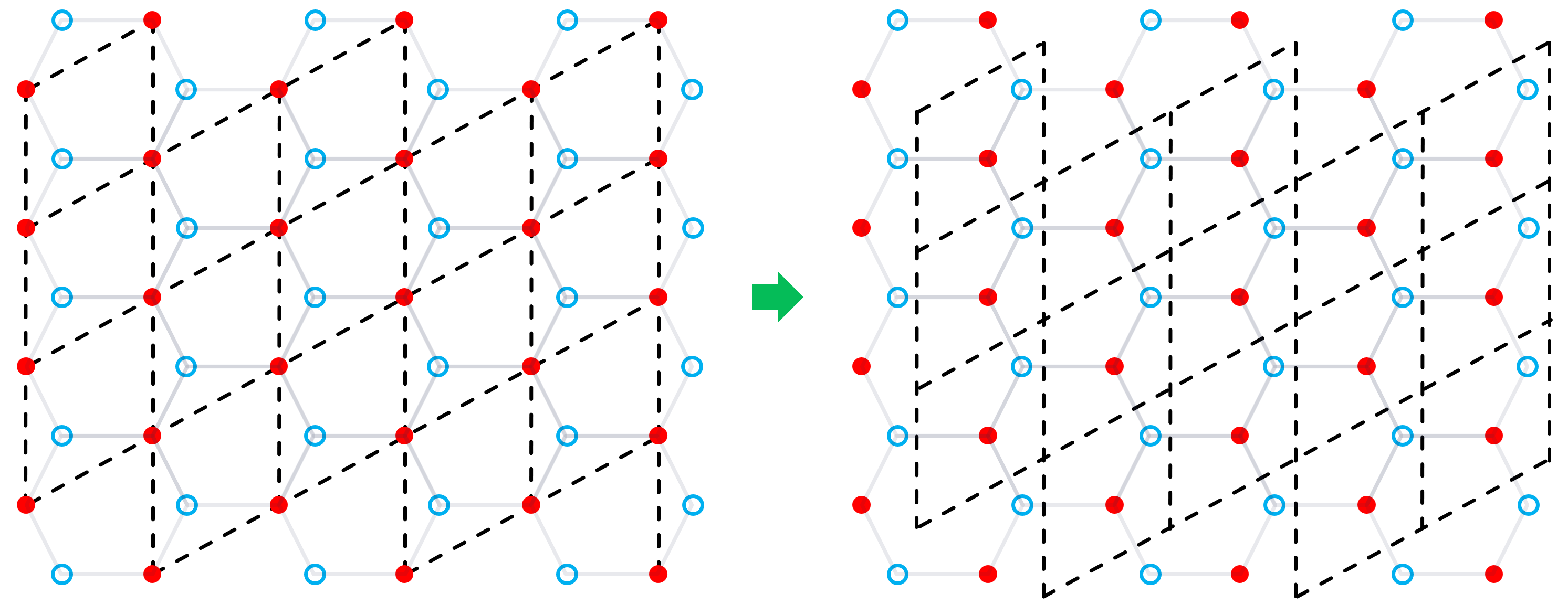
On the left, the lattice points stay on top of the red solid circles whereas on the right hand side, we shift the whole lattice. The lattice is still the lattice, totally independent of where we put it – the only thing that changes is the position of those circles (the decoration of the lattice) but that does not matter at all regarding the description of the periodicity, with the lattice.
Clarifying what we mean by lattice, we can talk about the lattice system,
-
It is a set of lattices
-
Lattices belonging to the same set (the lattice system) shares something
-
The thing they share is the lattice point group, called the holohedry.
Two things, I guess, that need some immediate explanation – lattice point group and holohedry. Earlier when we were talking about the crystal system, I said that the crystal system classify crystals with respect to the crystal structure according to their point groups. Given the clarification of what a lattice is – abstract points without concrete objects decoration – we can say that the crystal point group refers to the system of the crystal structure that has the underlying lattice decorated with concrete objects. Then it should become apparent what the lattice point group means – it refers to the point group of the lattice points without any decorations. Again, let’s look at an example,
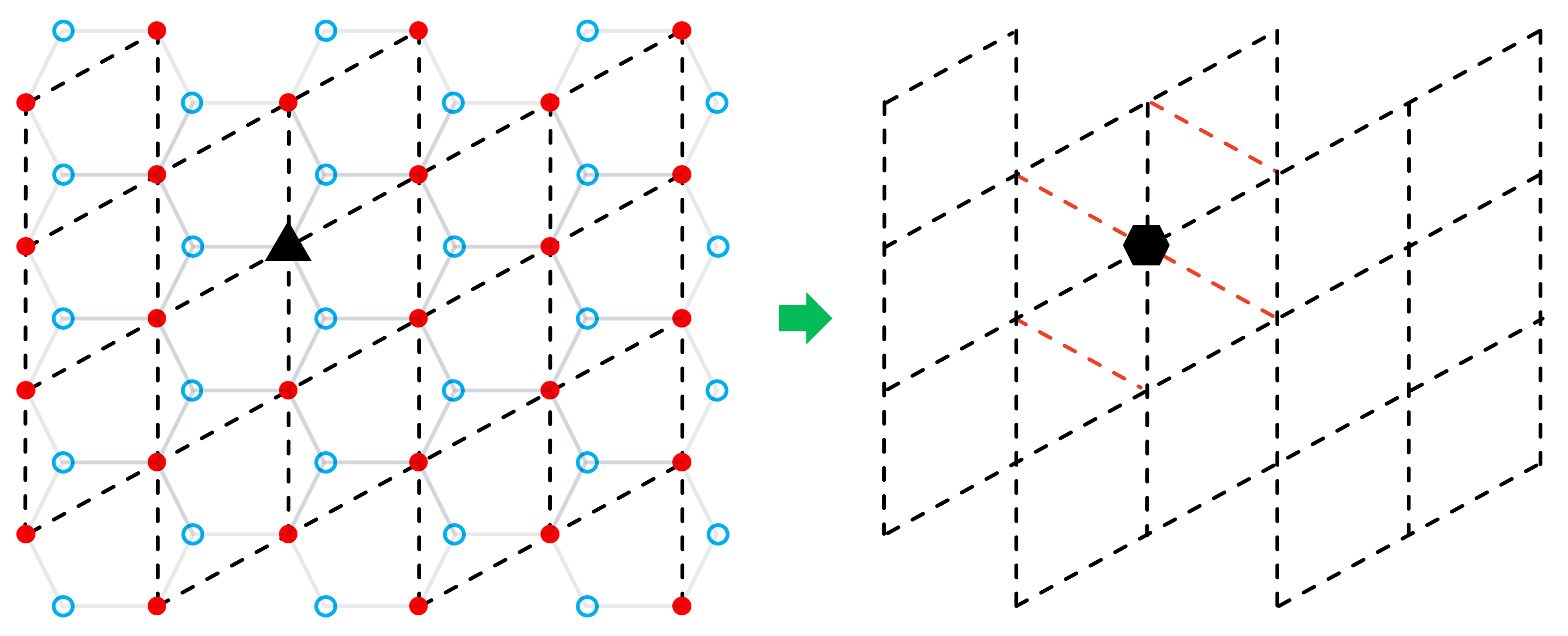
In the left figure, we have the lattice decorated with concrete objects, making the original honeycomb. In this case, a typical symmetry element is a 3-fold rotation axis as labeled out in the figure. On the right, though, I removed all the decorations, leaving only the lattice, where we can see the symmetry is changed – the same rotation axis now becomes 6-fold (the red dashed lines are added to guide our eyes only). So, the left decorated lattice has its point group which is the one used for crystal system classification while the right undecorated lattice also has its point group which is the one used for lattice system classification.
Based on the notes above, if the point group of a crystal is identical to that of the lattice (removing all the decorations), the point group is called holohedral, and the corresponding geometric crystal class [4] (one-to-one mapping to the point group) is called a holohedry [5].
The Hexagonal Family
The following table is part of the table on Wikipedia on crystal system and it is worth some noting,
| Crystal families | Point group classification | Space groups | Lattice classification | ||
|---|---|---|---|---|---|
| Crystal systems | Point groups | Bravais lattices | Lattice systems | ||
| Hexagonal | Trigonal | 5 | 7 | 1 | Rhombohedral |
| 18 | 1 | Hexagonal | |||
| Hexagonal | 7 | 27 | |||
For the hexagonal crystal system, it is clear that the corresponding lattice systems are all hexagonal. Intuitively understandable, fine. But for the trigonal crystal system, the splitting into two lattice systems need some explanation. For structure falling into the trigonal crystal system, when we have decorations, the point group is one of the following \(3, \bar{3}, 32, 3m, \bar{3}m\). However, when removing all the decorations from the lattice, the underlying lattice (i.e., how the system repeat itself in space) may be different, giving different lattice systems. Each and every one of the 5 point groups in the trigonal crystal system can have two lattice point groups (or, holohedries) – the rhombohedral lattice system corresponds to the holohedry \(\bar{3}m\) and the hexagonal lattice system corresponds to the \(6/mmm\) holohedry.
Each of the lattice systems support a series of space groups and we usually call them either rhombohedral space groups or hexagonal space groups, respectively for those belonging to the rhombohedral or hexagonal lattice system. Here is the full breakdown,
| Point group | Hexagonal (P) space groups | Rhombohedral (R) space groups |
|---|---|---|
| \(3\) | \(P3, P3_1, P3_2\) | \(R3\) |
| \(\bar{3}\) | \(P\bar{3}\) | \(R\bar{3}\) |
| \(32\) | \(P312, P321, P3_112, P3_121, P3_212, P3_221\) | \(R32\) |
| \(3m\) | \(P3m1, P31m, P3c1, P31c\) | \(R3m, R3c\) |
| \(\bar{3}m\) | \(P\bar{3}1m, P\bar{3}1c, P\bar{3}m1, P\bar{3}c1\) | \(R\bar{3}m, R\bar{3}c\) |
It can be noticed in the table that all rhombohedral space groups start with R in their Hermann-Mauguin (HM) symbols. This is also something worth noting. For all those rhombohedral space groups, we have two choices for the conventional unit cell – the rhombohedral cell or the hexagonal cell. When choosing the hexagonal cell, the unit cell is rhombohedral centered (i.e., having an atom at the origin automatically brings in another two atoms in the cell) and therefore the letter R is used to indicate such centering. However, it should be pointed out that the R-centered hexagonal is not really a Bravais lattice (pause for a bit and think about it – we all know that we have 14 Bravais lattices in 3D, but do we really understand what a Bravais lattice is? Will come back to this). Since they are rhombohedral space groups and belong to the rhombohedral lattice system, for sure, the actual lattice is rhombohedral and it is primitive. Therefore, another choice of unit cell is obviously the rhombohedral cell, no centering at all. Two things to note. One is, we will use the letter R in the HM symbol anyways (even it is primitive rhombohedral lattice), with the purpose of distinguishing from those primitive trigonal space groups with hexagonal lattices [6]. Second is, the hexagonal cell is more commonly used since it is visually less tilted and easy to visualize [7].
Bravais Lattice
I have talked about the lattice above, and the Bravais lattice is actually just the lattice, by definition. When we say Bravais lattice instead of lattice, we just want to emphasize that we are specifically talking about those 14 types of lattice in 3D and 5 in 2D. So, Bravais lattice is a smaller set of lattices, under the umbrella of the lattice system. So for a specific lattice, before we tell its Bravais lattice type, we should first tell what lattice system it belongs to. Let’s take an example to demonstrate.
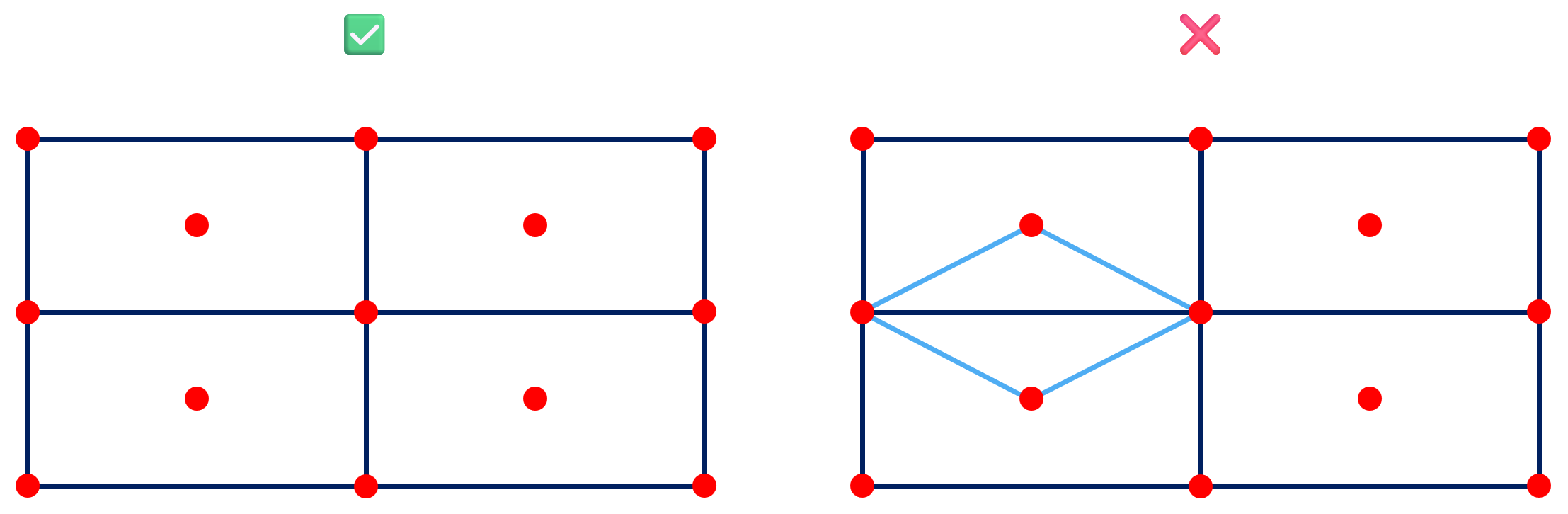
In the figure, I present the rectangular centered (\(oc\)) lattice in 2D, on the left. On the right, I am drawing it a bit differently to give a ‘oblique’ lattice (indicated by the light blue lines). Is it really an oblique lattice? Apparently not. But why? Because the actual symmetry of the lattice is \(2mm\) (the rectangular lattice system) but not \(2\) (the oblique lattice system). Therefore, the top level hierarchy is the rectangular lattice system for the lattice, and under the umbrella, we have that the rectangular lattice is centered, thus centered rectangular Bravais lattice (\(oc\)). Let’s take a look at another case,
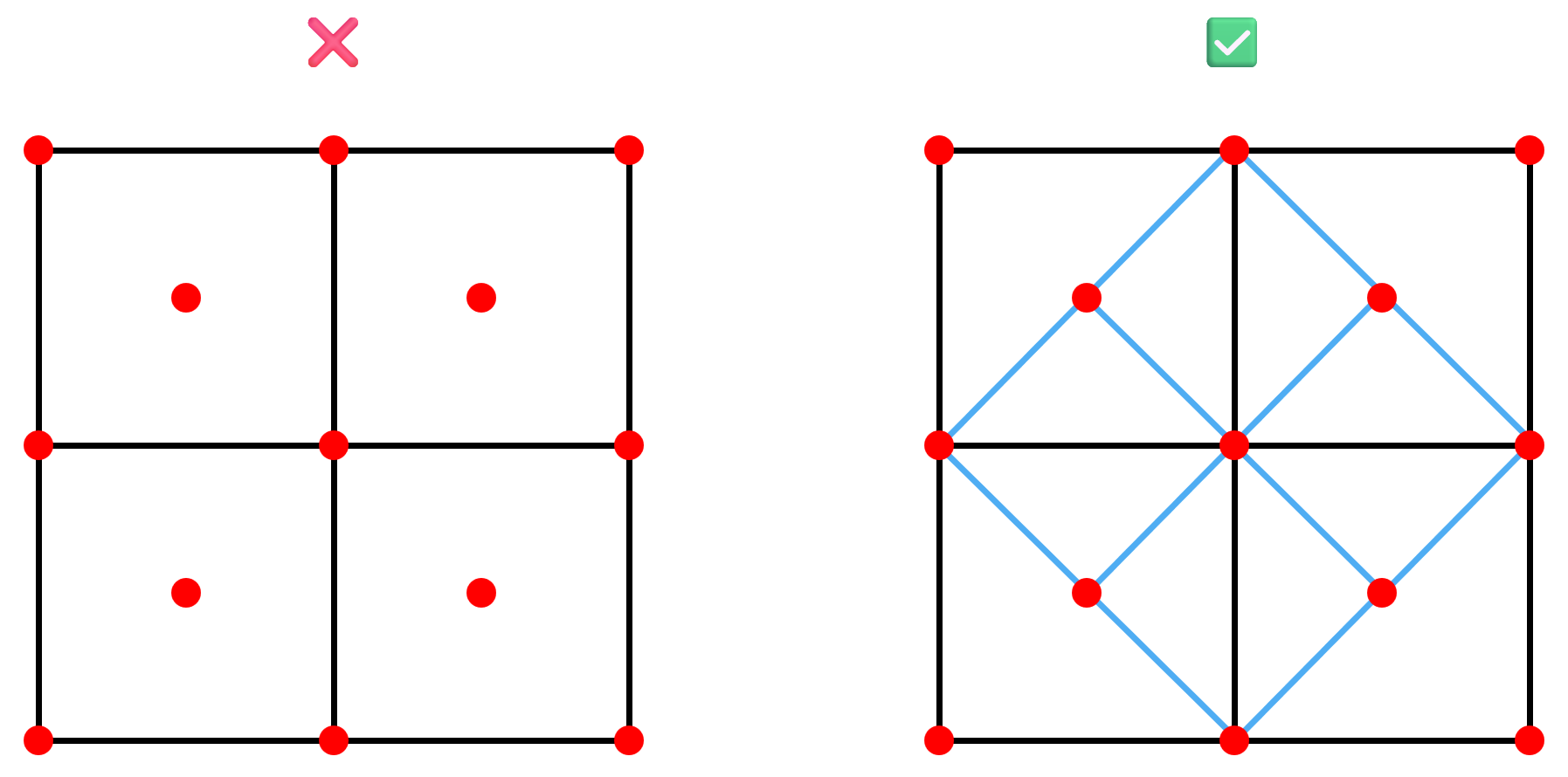
In this case, we have all those rectangles in the previous case becoming squares, and this makes some difference. On the left is presented the ‘centered square’ lattice. But do we really have a centered square lattice? The answer is No. Why? Because we realize that if we view the lattice from another perspective, as guided by the light blue lines, it is actually just a square lattice without centering. Same trick as in the previous case, but this one works due to that the ‘tilted’ lattice (it actually does not make that much sense to say a lattice is tilted but here I mean the visual effect only) does respect the lattice symmetry, namely the \(4mmm\) lattice point group.
References
[1] Crystal_system#Crystal_classes.
[2] Crystal system.
[4] Holohedry.
[6] Space Group Notation.
[7] International Tables for Crystallography, Volume A, 5th edition.